Texts
I choose engaging books that lightly align to what your child is covering in school. Joy Hakim's histories are a solid anchor for this, since her range covers most of what a student encounters in a typical American history sequence.
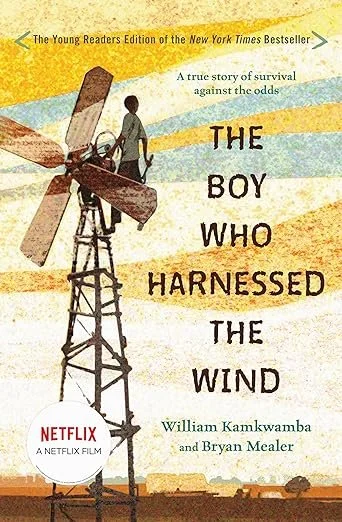
Not every text needs to track the curriculum, though. Books like The Boy Who Harnessed the Wind or The Disappearing Spoon are chosen for other reasons such as a compelling voice, a subject a student is drawn to, or a global perspective the standard curriculum doesn't offer. These alternatives show the range of what's possible when a family wants something different. Families with their own preferred text are welcome to reach out; a brief consultation will determine whether it's the right fit for the program.
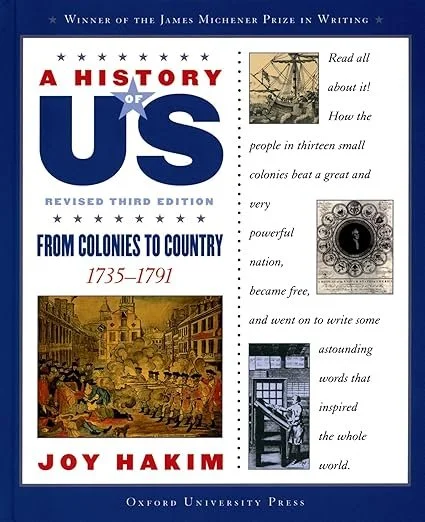
Joy Hakim — A History of US series (10 volumes, Oxford University Press) Grades 4–7 (with some volumes appropriate through grade 9). Hakim writes American history the way it should be taught: as a story with stakes, characters, and consequences rather than a sequence of dates. Short chapters and a direct, conversational voice make her work accessible to younger students while generating strong analytical writing opportunities around cause, effect, and argumentation. The series spans the full arc of American history, from prehistory through the present day, allowing sessions to move to whatever period best fits a student's interests or coursework.
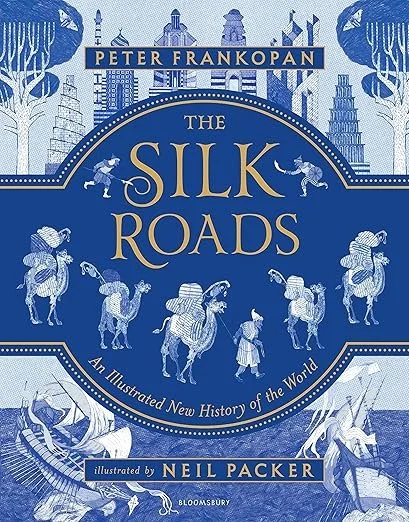
Peter Frankopan — The Silk Roads: The Extraordinary History that Created Your World (Illustrated Edition) Grades 5–9 A world history that deliberately recenters the story away from Europe, tracing the connections, trade, disease, religion, war, that shaped civilization across Asia, the Middle East, and beyond. Rather than a narrative built around a small cast of characters, this book covers vast chronological and geographic ground in a single volume, closer to a rich reference than a linear story. That makes it a strong fit for a student ready to range independently across a broad landscape and develop their own research angle, particularly useful for honors-track students building an independent project. For students whose own histories aren't well represented in Western curricula, it also offers a genuinely different vantage point on world history.
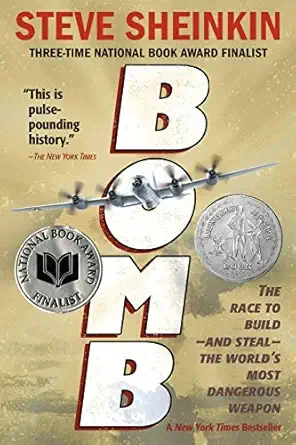
Steve Sheinkin — Bomb Grades 7–9 Narrative history of the Manhattan Project, told across three interwoven threads: the American scientists racing to build the bomb, the Soviet spies trying to steal it, and the Norwegian saboteurs trying to stop it. Sheinkin writes history with the pacing of a thriller. The moral complexity (the bomb ends one war and inaugurates another kind of terror) makes this one of the richest texts on the list for structured argumentation. Note: contains wartime violence and mature historical themes; recommended for grades 7 and up with parent awareness.
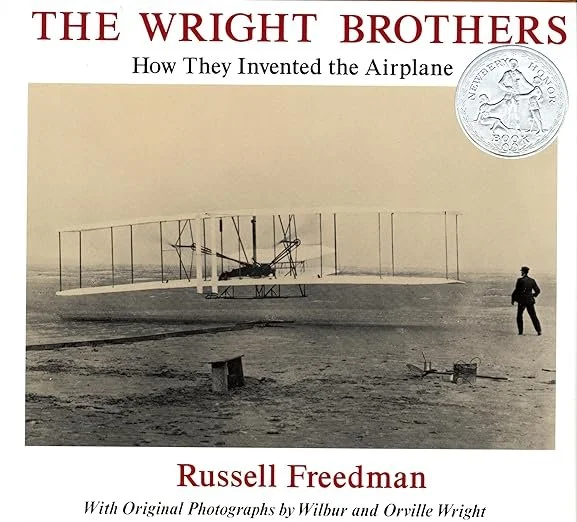
Russell Freedman — The Wright Brothers: How They Invented the Airplane Grades 5–8 A Newbery Honor biography built around the brothers' own photographs and correspondence. Freedman presents Orville and Wilbur not as mythic inventors but as methodical, persistent problem-solvers, which makes the book as much about how rigorous thinking works as about aviation. Strong for writing about process, evidence, and the relationship between failure and discovery.
Sam Kean — The Disappearing Spoon (Young Readers Edition) Grades 5–8 Stories from the periodic table (espionage, rivalry, obsession, accidental discovery) that make chemistry's history as compelling as any thriller. The Young Readers Edition retains Kean's voice and scientific substance while bringing it within reach of middle school readers. Particularly effective for students who don't yet see themselves as science readers.
William Kamkwamba & Bryan Mealer — The Boy Who Harnessed the Wind (Young Readers Edition) Grades 5–8 A Malawian teenager, facing a drought that threatens his family with starvation, teaches himself physics from library books and builds a working windmill from scrapyard parts. Science, perseverance, and economic hardship are woven together in a first-person voice that is unusually direct and emotionally honest. For students from non-Western backgrounds, the directness of Kamkwamba's voice and the universality of his situation make this a text with strong potential for personal, grounded writing.
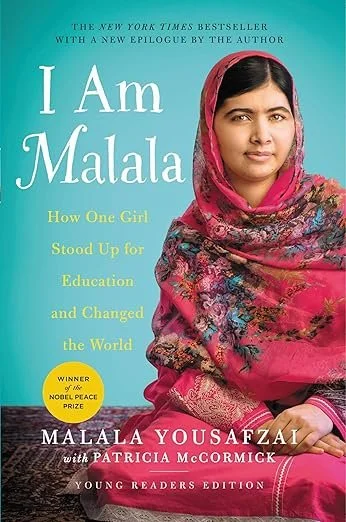
Malala Yousafzai — I Am Malala (Young Readers Edition) Grades 7–9 A memoir in which the young author herself takes a stand for learning, for girls, for the right to think freely. Set in Pakistan's Swat Valley, it brings a world most students have not encountered into close, human focus. The content is serious: extremism, violence, and political repression are present throughout. Recommended for grades 7 and up with parent awareness.