
Independent Reasoning.
Precise Expression.
Stronger Students.
Academic development for capable bilingual students ready for more.
In-person to start • Ongoing lessons via Zoom • For families that want more • Evening and weekend availability
For Bilingual Families
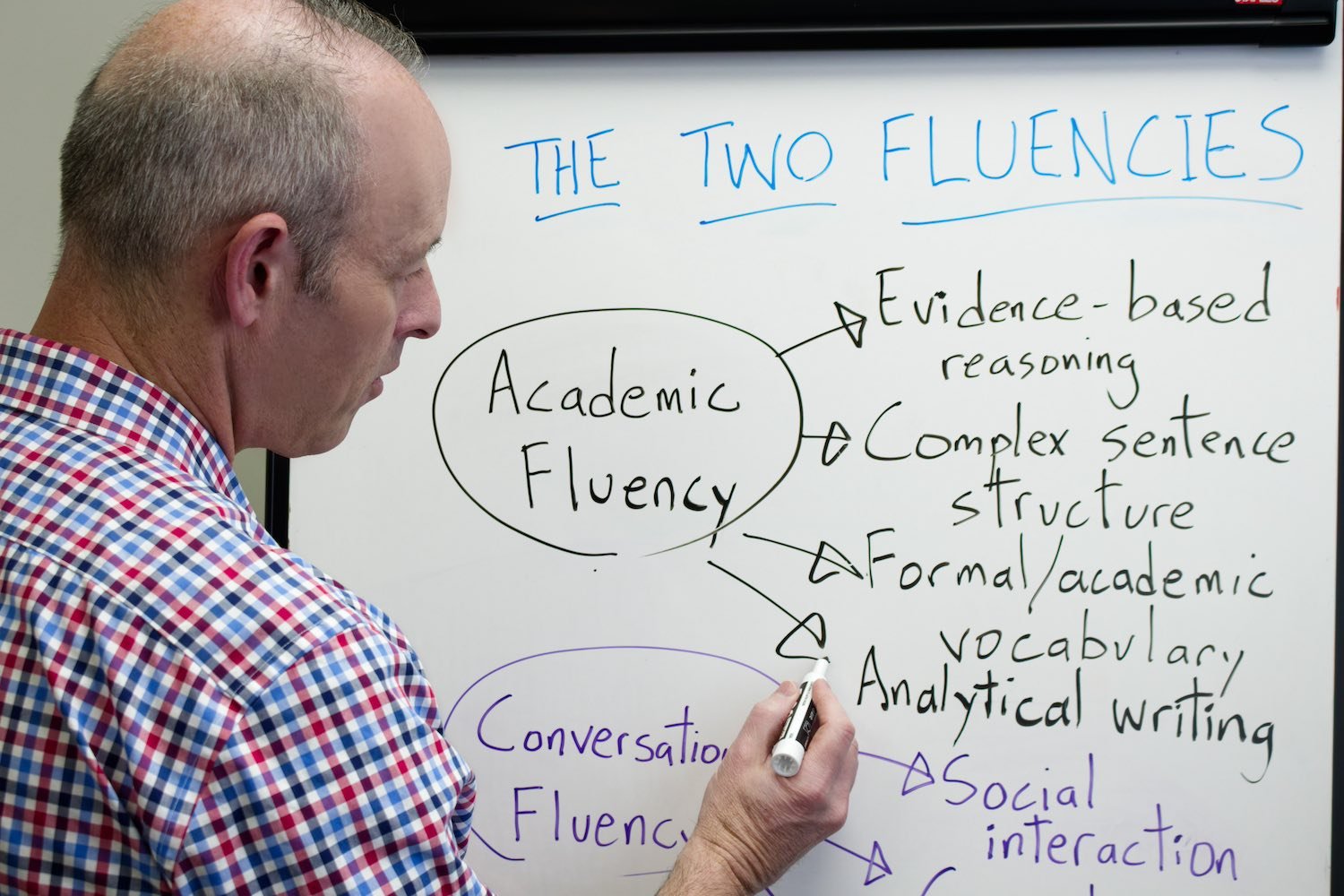
Many capable students from bilingual households share a common and largely invisible gap. Conversational fluency, the English of everyday interaction, friendships, and play, develops naturally, and to everyone around them, including teachers, the student appears totally fluent and will be judged as such. But academic fluency, the formal register of analytical essays, structured argumentation, and demanding texts, develops more slowly and requires explicit instruction. A child who can hold a sophisticated conversation about, say, Minecraft, in English may still struggle to put a precise, well-grounded argument on the page. But to the educational system, your child is underperforming.
This gap has a name: The Two Fluencies. It is not a learning problem. It is a development gap, and it is highly responsive to the right kind of instruction. For students from non-English-speaking households, closing this gap is often the single most correctable barrier between their current academic performance and their actual ceiling.
This isn't about getting tonight's worksheet done. It's about building the underlying skills that make your child stronger in the classroom, this term and beyond.
What Happens in Sessions
Lessons are creatively designed to support students’ work in school. This involves reading complex texts aloud, wrestling with formal vocabulary in context, and building students’ verbal and written expression. Every custom-designed unit builds toward independent, analytical writing that supports their growth in school and develops students’ academic register. Along the way, it also creates a retrievable record of growth that compounds, over time, into a longitudinal portrait of academic development.
Families that want a custom learning experience are welcome to propose their own texts.
I serve learners in 4th through 9th grade.
I don't shadow your child's classroom day to day. Instead, I look at what's coming, a unit, a test, a set of related topics, and build sessions that go deep on a meaningful slice of it, well before the pressure of a test arrives. That gives your child real command of some of what they're learning, and with it, more confidence walking into class.




The Two Temptations
Independent reasoning is harder to build now than it used to be, because students must contend with what I call The Two Temptations. First, constant device use fragments attention before a student can even begin to think something through. Second, AI tempts a child into skipping the thinking altogether, letting a model reason for them instead. Both corrode a child's capacity for independent thought. At The Young Stoics, sessions are purpose-built to protect against both temptations and to foster genuine reasoning and precise written expression. We work to nurture students’ capacity for sustained, undistracted focus, and we use AI deliberately — as a tool to sharpen a student's own thinking, never as a substitute for it.
The Approach
Academic language develops through deliberate practice under structured conditions.
Every student I work with receives focused individual attention regardless of format, whether one-on-one or in a small group. After every session, families receive a detailed written report documenting not just what was covered, but details about how your child is engaging with the material. Once monthly or quarterly, I conduct a broader assessment that takes a longer view of the student's learning. There's even a Longitudinal Portfolio Report available — a formal, sophisticated analysis of your child's growth in writing and reasoning, suitable for school or personal use.
This reporting structure is not incidental. It is how longitudinal development becomes visible, to the family, to the student, and to any educator who works with that student next.
Enrollment is deliberately limited.
Contact
Limited spots available. To get started, email to schedule an initial diagnostic session.